Tamsin Isaac
PhD Researcher
MY RESEARCH
Understanding Limited-Time Events in Digital Games
My PhD research investigates how limited-time events are designed, experienced and used to shape player engagement, disengagement and re-engagement in digital games.
Combining large-scale cross-platform analysis, player diaries and interviews, longitudinal engagement data and industry research, my work examines limited-time events from both player and developer perspectives.
Why Limited-Time Events?
Limited-time events are a common feature of contemporary digital games, ranging from seasonal celebrations and daily challenges to tournaments and time-limited collaborations. By restricting when content, activities or rewards are available, these events can create new reasons to play and return to a game—but they can also introduce pressure, repetition and competing demands on players' time.
Despite their widespread use, limited-time events have received relatively little research attention as a distinct form of game design. My research addresses this gap by examining what these events look like across games, how players experience them, how they relate to patterns of engagement, and how these insights can inform their design in practice.
Research Programme
The project moves from understanding the design space to examining player experience, behavioural engagement and industry practice.

01 · MAP
Mapping the Design Space
The first stage of my research examines how limited-time events are designed and how prevalent they are across digital games. I developed a multidimensional taxonomy through iterative conceptual and empirical analysis and applied it to 2,670 games across Steam and Google Play.

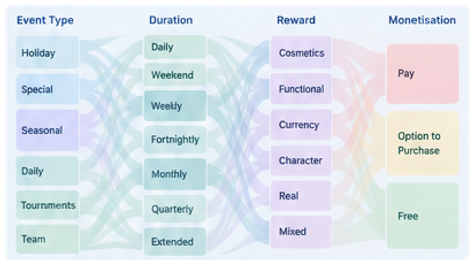
Example view of the limited-time event taxonomy, showing relationships between event type, duration, reward and monetisation.
02 · EXPERIENCE
Understanding Player Experience
The second stage moves from games to players, exploring how limited-time events fit into everyday play. Participants documented their experiences over a two-week diary study, followed by interviews examining their decisions, experiences and responses to time-limited content.
17
Player diaries
11
Interviews
2 weeks
Diary period
03 · MEASURE
Measuring Engagement
98
Steam games
349+
Limited-time events
Longitudinal
Engagement analysis
The third stage examines how limited-time events relate to changes in player engagement over time. Using longitudinal player activity data, I compare engagement before, during and after events while considering the wider trajectory of each game.
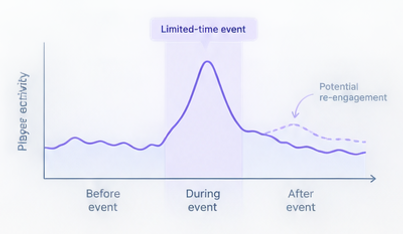
This approach allows event outcomes to be compared across different event formats, game sizes and engagement contexts.
04 · APPLY
Connecting Research and Practice

The final strand examines limited-time events from a developer perspective, exploring how event success is understood, what informs design decisions, and how player and engagement outcomes are evaluated in practice.
Alongside this research, I completed a Knowledge Exchange placement with Gritstone Games, providing an opportunity to apply research insights within a commercial game-development context.

05 · METHODS
Methods & Approaches
My research combines qualitative, quantitative and industry-facing approaches to examine limited-time events at multiple levels.

Taxonomy Development
Qualitative Analysis

Content Analysis

Longitudinal Game Analytics

Diary Studies

Mixed Methods

Semi-structured Interviews

Industry Research

06 · SYNTHESIS
Bringing the Evidence Together
Together, these studies examine limited-time events at multiple levels—from their design across digital games, to players' lived experiences, patterns of behavioural engagement, and their development in industry practice.
DESIGN
What do LTEs look like?


EXPERIENCE
How do players experience them?
BEHAVIOUR
How do they shape engagement?


PRACTICE
What can this mean for design?
By connecting these perspectives, my research aims to build a more comprehensive understanding of how limited-time design shapes player engagement and how this evidence can support game design practice.